Campaign management for tabletop games
Dungeon Ledger
Shared campaign notes for D&D and tabletop groups.
Your campaign, remembered.
Dungeon Ledger is a shared notebook for your tabletop campaign — one place where the whole group takes notes together. Notes your players can actually see, linked into a map of your world, with the secrets kept firmly on your side of the screen.
Free to start. No card, no trial clock — six campaigns as DM, unlimited as a player.
Notes
Written once, revealed when you say so
Every note carries its own visibility. Share the tavern’s floor plan with the table, keep the innkeeper’s real name to yourself, and reveal it the session it finally matters.
Players see what you’ve shared and what they wrote themselves. DM-only and secret notes never reach their browser at all — the filtering happens on the server, not in the interface, so there’s nothing to find in the page source.
Seven note types come with templates worth using: player characters, NPCs, locations, quests, session logs, secrets and plain notes.
More on how a group shares one notebook without spoiling itself: shared D&D notes your players can actually read, and what belongs in a session log.
Connections
A world that links itself
Type [[ and start naming things. A search drops down as you type; pick a note and the mention becomes a link.
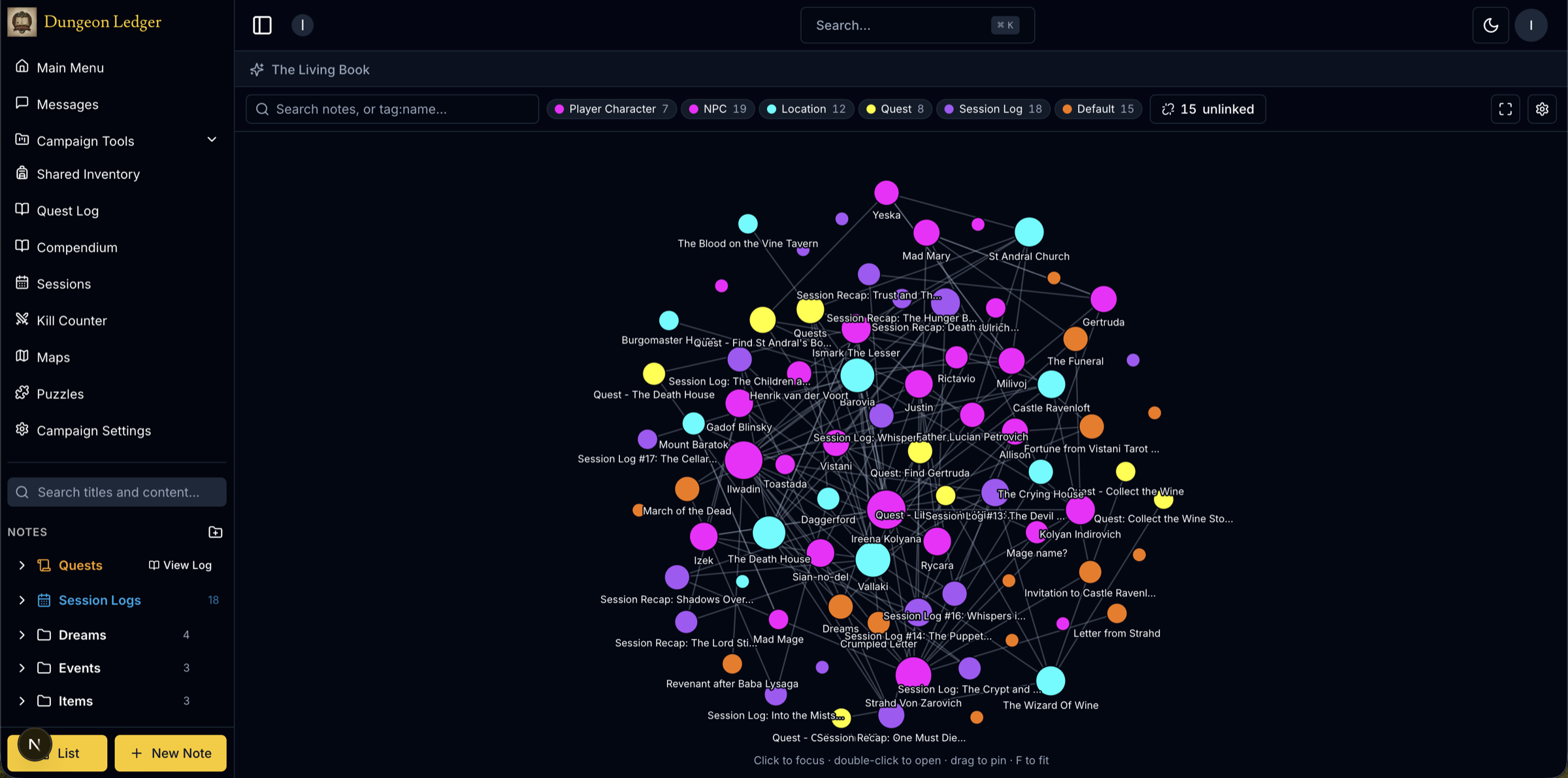
Every link becomes an edge in your campaign’s graph — who knows whom, which cult meets in which cellar, and which thread you left dangling four sessions ago. Nodes are coloured by type, and clicking one opens the note.
It’s the fastest way to answer the question every DM dreads mid-session: wait, who was that again?
It is also how you end up with a D&D campaign wiki without ever setting out to build one.
The Living Book
An oracle that only knows what you know
The Living Book sits in a tab beside your notes and answers questions about the campaign, citing the notes it drew from.
It’s built so it can’t leak. The server selects the notes the person asking is permitted to read before the model sees anything, so a player’s question can only ever be answered from a player’s notes. Ask it something only the DM knows and it will tell you your information must have been taken by a False Hydra.
DMs get more rope: when the notes genuinely don’t cover something, the Book can offer outside suggestions — clearly separated from canon, and only when explicitly asked.
The mechanics of it, written up: keeping DM secrets separate from player-visible notes.
Safe passage for his daughter out of the city before the next tenday, in exchange for the manifest of the Sea Maiden.
Sources — Session 11 · Harbourmaster Vell
The rest of it
Everything else you keep in other tabs
Compendium
SRD monsters, spells, races and classes are seeded on day one. Add your own homebrew alongside them.
Soundboard
Queue the music once as DM. Every player’s browser follows the same clock, so the drop lands at the same moment for everyone.
Puzzles
Seven kinds of playable puzzle — ciphers, dials, logic gates, sequences — with optional skill-check gates and hidden clues.
Sessions
Put the next session on a shared calendar, and keep the log of what happened attached to the session it happened in.
Maps
Upload your maps and pin the places that matter, linked back to the notes that describe them.
Dice & counters
Roll without leaving the page, and keep a shared kill counter that ticks up live on every screen at the table.
There are also 12 free tools that need no account at all — an encounter builder, a CR calculator, an initiative tracker and the rest. They run entirely in your browser. Browse the free D&D tools.
* Some tools are still in development and may not yet be usable to their full capacity.
If you run the game
- Prep in the same place you improvise — the secret note and the shared one live side by side.
- Reveal information deliberately: flip a note from DM-only to shared the moment the party earns it.
- Stop losing the thread between sessions; the graph remembers the connections you made in month one.
- Run music, puzzles and the compendium without another dozen browser tabs.
Written for the person behind the screen: how to keep Dungeon Master notes.
If you sit at the table
- Keep your character sheet, backstory and private scheming in one place your DM can’t accidentally spoil.
- Catch up on what you missed by reading the session log instead of asking at initiative.
- Ask the Living Book what your character would plausibly remember, without trawling twelve sessions of notes.
- See the same map, hear the same music, roll in the same window.
It works the same way for any system, not just D&D — tabletop campaign notes for the whole table.
Questions
- Is there a shared note-taking app for D&D groups?
- Yes. Dungeon Ledger is a shared notebook built for tabletop groups: the whole table writes into one campaign, every note syncs live, and each note carries its own visibility so the DM can keep secrets on the same page the players are reading. It runs in the browser and installs to a phone as an app.
- How do we keep DM notes hidden from players?
- Every note has a visibility setting — shared with the table, private to you, DM-only, or shared with specific people. Filtering happens on the server before a note is sent, so a player’s browser never receives the content of a note they aren’t allowed to read. There is also a dedicated secret note type for the things you are saving for a reveal.
- What is the best way to take tabletop campaign notes as a group?
- Keep one shared source of truth rather than notes scattered across each player’s own app, link entries to each other so people and places stay connected, and control visibility per note instead of maintaining a separate secret document. Dungeon Ledger is built around those three things: shared campaign notes, wiki-style [[links]] that build a map of your world, and per-note permissions.
- Does it cost anything?
- No. A free account lets you run up to six campaigns as a DM and join as many campaigns as you’re invited to. Paid plans aren’t live yet, and nothing in the app asks for a card.
- Can my players edit the notes?
- That’s your call, per note. Editing can be limited to the author, the author plus the DM, opened to all players, or granted to specific people. Visibility is a separate setting, so a note can be readable by the table but editable by one person.
- Is this an official product of any game publisher?
- No. Dungeon Ledger is an independent tool. Its compendium is seeded from the 5e System Reference Document, but the app isn’t affiliated with, endorsed by, or sponsored by Wizards of the Coast or any other publisher.
- Does it work on a phone?
- Yes. It’s a progressive web app, so you can install it to your home screen and it behaves like a native app at the table.
- What happens to our campaign data?
- It stays yours. We don’t sell it and we don’t train models on it — the AI features only ever receive the specific notes needed to answer the question in front of them. The details are in the privacy policy.
Your data
What signing in with Google shares
You can create an account with an email address and password, or sign in with Google. If you choose Google, Dungeon Ledger receives three things, and uses each of them for one purpose:
- Your name
- Shown to the other people in your campaigns, so the table can see who wrote a note or scheduled a session.
- Your email address
- Identifies your account, delivers campaign invitations and session reminders, and lets you recover access if you get locked out.
- Your profile picture
- Used as your avatar beside your notes and messages. You can override it per campaign.
That is the whole of it. We don’t request access to your Gmail, Drive, contacts or calendar, we never post anything on your behalf, and we don’t sell your data or train models on your campaign notes.
Read the full privacy policyRead on
Guides, free tools, and writing about running a table
Guides
What shared campaign notes look like in practice, by the way people go looking for them.
Free tools
12 calculators and trackers that run entirely in your browser. No account, no sign-in, nothing to install.
- Dice roller
- Initiative tracker
- Encounter difficulty calculator
- Name generator
- Dice probability calculator
- Session notes templates
- XP split calculator
- Travel time calculator
- CR calculator
- Condition tracker
- Spell slot tracker
- Coin & weight calculator
From the blog
Notes on running a campaign, and on keeping the record of one.
- Running combat faster without cutting cornersWhere 5e combat actually loses time — bookkeeping, not decisions — and the specific habits that get a table back to four or five rounds an hour.
- How to take D&D session notes your players will actually readA short, repeatable structure for session logs — what to record, what to leave out, and how to stop note-taking from competing with playing.
- How to share campaign notes with your players without spoiling anythingWhy the two-document approach always breaks, and what per-note visibility does instead — including what players should be able to write themselves.
Bring your table with you
Start a campaign, invite your players, and write the first note before next session.
Create your campaign